
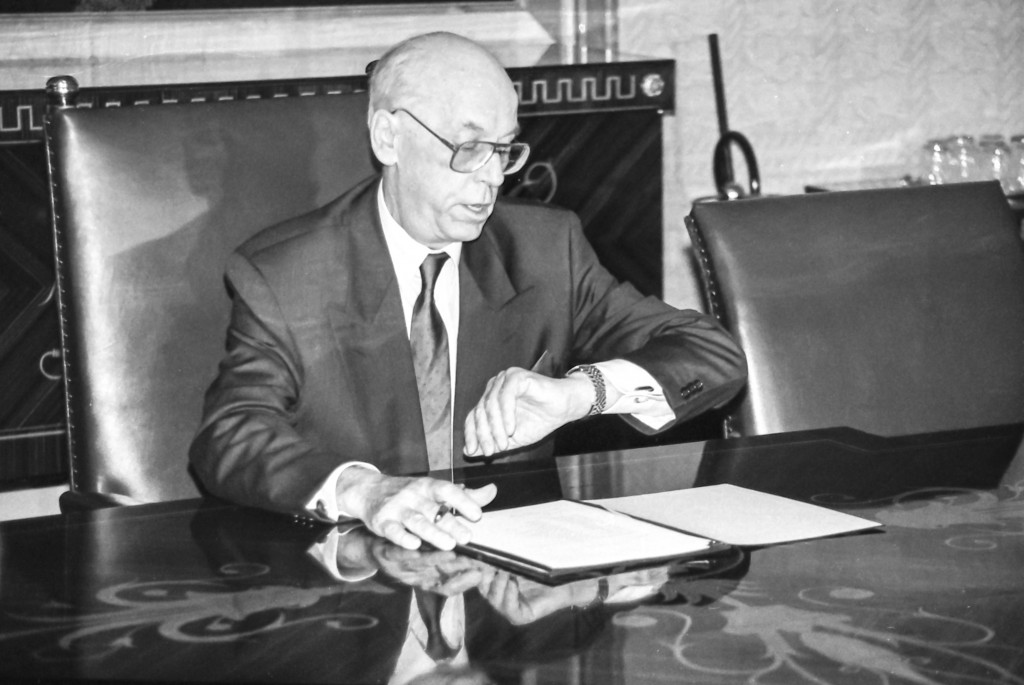

Lennart Meri was born on 29 March 1929. Already as a child, while living abroad with his father, the Estonian diplomat Georg Meri, he experienced the joys and pains of the life of a diplomat. He spent his school years in Paris, Berlin, Tallinn, and Tartu.
In 1941, the Meri family, like many other Estonian families, were hit by the repressions of the occupying Soviet forces – their whole family was arrested and sent to exile in Russia. They only returned to their homeland in 1946.
Meri began his studies at the University of Tartu while also working as the dramatist of the Vanemuine Theatre. This was followed by a job as an editor at the Estonian Radio in 1956 and as a director at the Tallinnfilm studios. In addition to translating several notable works, his legacy also includes research on the Finno-Ugric peoples of Siberia, and recording their life on film as well as in books.
Lennart Meri also played an essential role during the Singing Revolution of 1988, when he was the Secretary of the Board of the Estonian Writers’ Union.
Meri began his studies at the University of Tartu while also working as the dramatist of the Vanemuine Theatre. This was followed by a job as an editor at the Estonian Radio in 1956 and as a director at the Tallinnfilm studios. In addition to translating several notable works, his legacy also includes research on the Finno-Ugric peoples of Siberia, and recording their life on film as well as in books.
Lennart Meri also played an essential role during the Singing Revolution of 1988, when he was the Secretary of the Board of the Estonian Writers’ Union.
In 1990, Lennart Meri was appointed Foreign Minister. The position required him to create the Ministry of Foreign Affairs, attract a staff of young people who would be quick learners, shape a reliable channel of communication with foreign states, and represent Estonia at the main international conferences. The Estonian Institute was founded as a non-governmental organisation on his initiative. Meri participated in creating a network of Estonian information offices in several capitals of the world and these later became the initial network of Estonian embassies and consulates. As a result of these activities, the first Estonian diplomats assumed their duties. His famous speeches and his remarkable, witty manner that attracted a lot of attention for Estonia dates back to his tenure as Foreign Minister and continued through the years he was in office as President of Estonia.
After a short spell as the Estonian Ambassador to Finland, he was elected President of Estonia on 6 October 1992, the first head of state to be elected following the restoration of independence. On 20 September 1996 Lennart Meri was re-elected for a second term as President of Estonia.
Lennart Meri - CV
- 1935-1938 164th Public School of Berlin
- 1938-1939 Lycée Janson de Sailly in Paris
- 1939-1941 Jakob Westholm School of Humanities for Boys
- 1941-1944 homeschooled by his mother
- 1944-1946 Jaransky High School in Siberia
- 1946-1948 10th High School of Tallinn
- 1948-1953 Tartu State University, Department of History and Languages, specialising in history
- 1953-1955 Dramatist at the Vanemuine Theatre, teacher at the Tartu Art School
- 1955-1961 Literary contributor and editor of radio plays at the Estonian Radio
- 1963 Became a member of the Estonian Writers’ Union, followed by a membership of the Union of Estonian Cinematographers
- 1964-1970 Became a member of the editorial board and director at the Tallinnfilm studios
- 1976-1978 back in Tallinnfilm
- 1986-1989 Secretary of the Board of the Estonian Writers’ Union
- 1988 founded the Estonian Institute as a non-governmental organisation and became its director
- 1990-1992 Estonian Foreign Minister
- 1992 (April to September) Estonian Ambassador to Finland
- 1992-1996, 1996-2001 President of the Republic of Estonia
Having worked as a writer, translator and filmmaker, Lennart Meri was among those great statesmen of the world whose talents included eloquence both in writing as well as in speech.
Selected works by Lennart Meri
- 1959 On the Tracks of Cobras and Karakurts (Kobrade ja karakurtide jälgedes)
- 1961 Ship Boys on the Green Ocean (Laevapoisid rohelisel ookeanil)
- 1964 To the Land of Fiery Mountains (Tulemägede maale)
- 1974 At the Gateway of the Northern Lights (Virmaliste väraval)
- 1976 Silverwhite (Hõbevalge)
- 1977 The Approaching Shores (Lähenevad rannad)
- 1981 A booklet in Finnish on shamanism
- 1984 Silverwhiter (Hõbevalgem)
- 1989 The Year 1940 in Estonia (1940. aasta Eestis), as part of a group of authors
A selection of documentary films by Lennart Meri
- 1971 Water Bird People (Veelinnurahvas)
- 1978 Winds of the Milky Way (Linnutee tuuled)
- 1985 The Voices of Kaleva (Kaleva hääled)
- 1989 The Sons of Torum (Toorumi pojad)
- 1997 Shaman (Šamaan)
Translations
Meri has translated works by Remarque, Greene, Vercors, Solzhenitsyn, Boulle, and others. A collection of speeches by Meri has also been published as a separate book.

