
The event was opened by Undersecretary of the Ministry of Foreign Affairs Mariin Ratnik, who noted that Poland is the world’s 20th largest economy and an increasingly important market for Estonia. “Our exports to Poland have exceeded one billion euros for the first time, and Poland is now our sixth most important export market. Unlike many other countries, this growth has come specifically from goods and industry,” Ratnik said.
The ambassadors’ panel featured Estonia’s Ambassador to Poland Miko Haljas and Deputy Head of Mission of the Polish Embassy in Estonia Anna Pełka. The diplomats agreed that bilateral relations are very good. Both countries share the same views on supporting Ukraine and on European security, which also supports the development of economic relations. The most active cooperation is currently taking place in the defence sector, but there is considerable potential in other areas as well.

“I recommend that all companies interested in the Polish market start with the export strategies presented here today,” Ambassador Haljas said.
The export strategy for Poland was presented by Civitta partner Martti Rell, who noted that it is accessible to all companies and provides an overview by sector of market opportunities, barriers, business culture and entry strategies, together with relevant contacts. “Poland is a large and highly competitive market with a growing consumer base. Our analysis shows that it is generally advisable to start with a specific region,” Rell said.
In the near future, Poland’s public sector will invest most heavily in transport, energy and defence. “Our analysis shows the greatest potential for Estonian companies in information, financial and clean energy technologies, as well as in the wood and defence industries. There are also opportunities in the food industry, maritime sector, and health and education technologies. In the food sector, it is difficult to compete in the mass market, but if you find smart niches with higher added value, opportunities do exist,” he added.
In the business panel, participants agreed that face-to-face communication and building trust with Polish partners are key. Compared to Estonia, television and offline advertising are also more effective. “Preparing for a meeting means there must always be biscuits on the table, and you need to be more patient. Poland is a large country and everything takes more time, but a successful pilot project can become your best ally and open doors in the Polish market,” said Markus Törnberg, Head of the Polish Market at Waybiller.

According to Jüri Martin, Member of the Management Board of Tavex, the company employs around 120 people in Poland. “Polish people are very conscientious, so cooperation and communication with the local team are generally straightforward,” he said.
According to Tomaš Pozlevič, Regional Sales Manager at Frankenburg Technologies, it is important to demonstrate a local presence in the market. “If nothing about you or your company appears in Polish on Google, it does not build trust. LinkedIn is an effective tool for finding contacts – if you genuinely offer value, people will respond and it is possible to arrange meetings,” Pozlevič explained.
Milena Zaszewska-Topczewska, Head of Julianus Inkasso Poland, noted that bureaucracy must also be taken into account. “We now have a digital system for submitting documents to the court. In court, it is still printed out, and then another document is printed to confirm that the first document is correct. Instead of one document, you suddenly have two,” she said, illustrating that paper will remain part of administrative processes for some time. She also advised always using local professionals for marketing materials – translated content often feels foreign to consumers and does not build trust.
The business panel was moderated by Arvo Anton, Head of the Division of Economic Diplomacy and Honorary Consuls, and also included Łukasz Musiałkiewicz, Head of Enefit Poland, whose company ranks among the 500 largest in Poland.
Representatives of the Polish–Estonian Chamber of Commerce, Artur Kuczmowski and Waldemar Król, spoke about services available to Estonian companies and strengthening business links between Poland and Estonia.

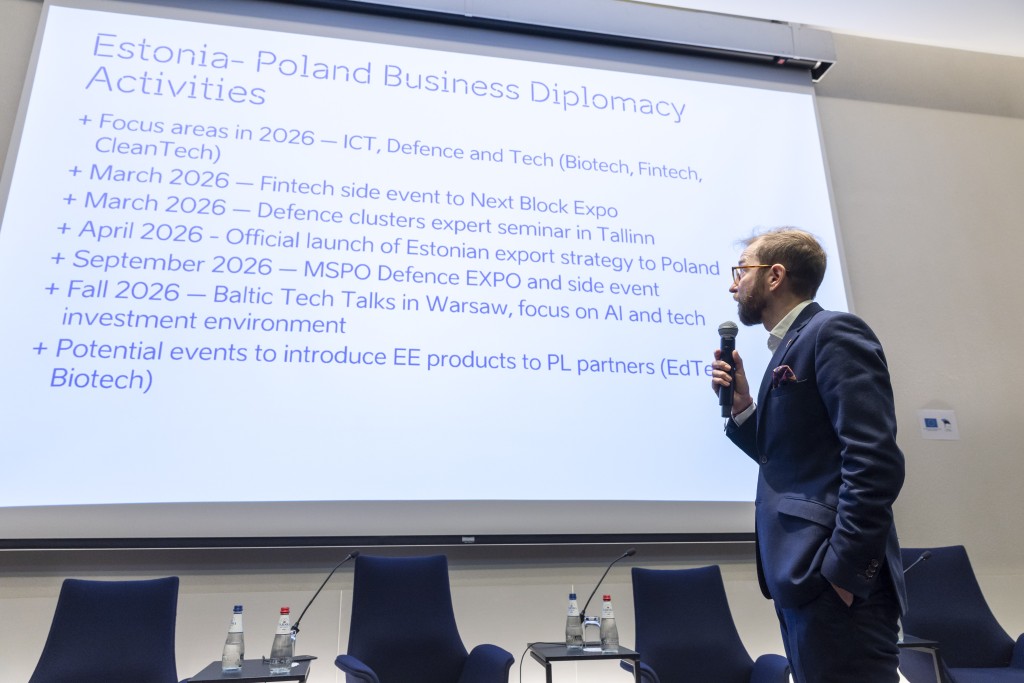
The event concluded with presentations by Daniel Bajer, Export Adviser for Poland at Enterprise Estonia (EIS), and Marika Lampi, Economic Diplomat at the Estonian Embassy in Warsaw, who introduced current activities and plans and encouraged businesses to seek advice and support.
The Poland business seminar was organised in cooperation with Enterprise Estonia (EIS).
All businesses interested in further information on opportunities in the Polish market are encouraged to begin with the Poland market strategy: Export to Poland

