
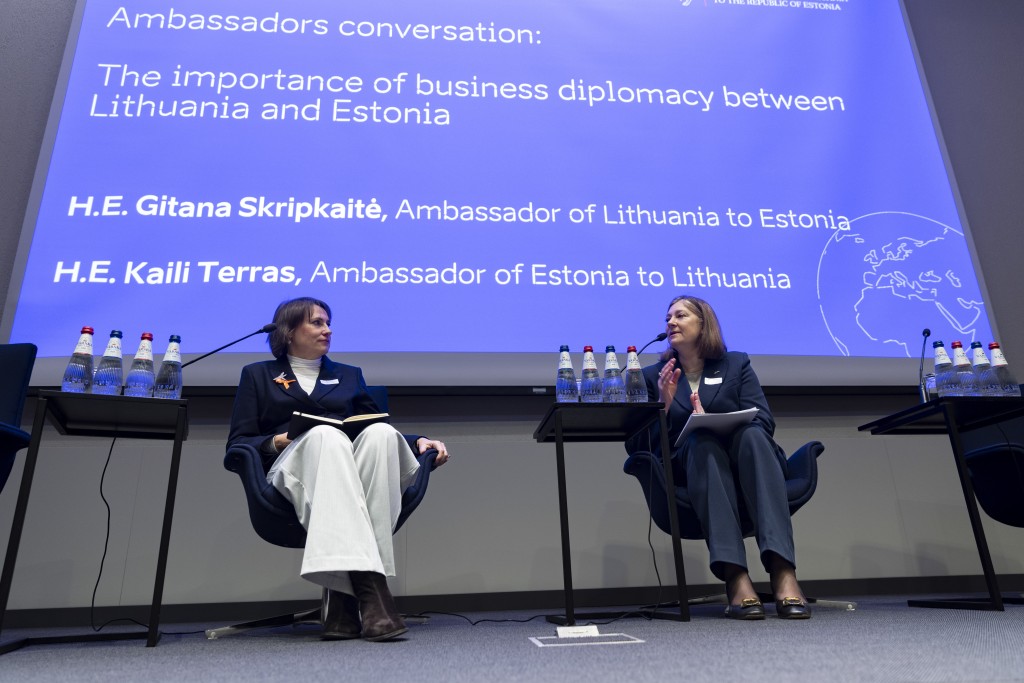
Estonia’s Ambassador to Lithuania, Kaili Terras, and Lithuania’s Ambassador to Estonia, Gitana Skripkaitė, welcomed the strong interest from entrepreneurs in cooperation. They agreed that Estonia and Lithuania have much in common, which also makes doing business easier.
“The embassy is here for you. We also have facilities where we can organise events together with entrepreneurs, and we always assist businesses on the local market. We also have several honorary consuls in Lithuania who can help with local contacts and insights,” said Terras.
An overview of Lithuania’s innovation system was given by Miglė Trinkūnaitė, Global Partnerships Manager at the Lithuanian Innovation Agency, while Robert Juodka, Chairman of the Board of the Estonian Chamber of Commerce, presented Lithuania’s business environment in general.
“Lithuania’s GDP has increased sixfold since 2000. Lithuania has focused heavily on industry and manufacturing, and many incentives and distinctions have been introduced to attract new investment,” Juodka explained, emphasising that Estonians’ reputation in Lithuania is very good. He advised that when expanding into the Lithuanian market, companies should take into account the local Competition Authority, which is very active and should be included when entering the market.

The entrepreneurs’ panel discussion featured Urmas Somelar, Member of the Management Board of Merko, Karl-Joonatan Kvell, CEO of Evecon, Tõnis Jõgeva, Sales and Partnerships Manager at 1Office, and Ingvar Pärnamäe, Co-Founder and CEO of Vegvisir.
According to Merko’s representative, the company has been operating in Lithuania for almost 30 years and currently employs 120 people there. “Although the whole Baltic region is like a home market for us, in Lithuania it is worth bearing in mind that many things are different – including culture, the tax system and the legal framework,” Somelar explained. He recommended that companies find someone within their team who is willing to relocate to Lithuania and learn to navigate the local system. In addition to the capital, companies should also consider various free economic zones and regions outside Vilnius, and look at where their specific sector is most strongly represented.
“Our main mistake was that we ignored Lithuania for too long. We should have looked in that direction earlier – there we are immediately treated as equal partners,” the CEO of Vegvisir said. He recommended making use of the support of the Estonian Embassy and relevant sectoral organisations, and attending business events and trade fairs where key decision-makers are present.

The representative of 1Office agreed that knowledge of the local language is important. “We used to rely on partners for everything, but we recently established our own team in Lithuania,” Sales and Partnerships Manager Tõnis Jõgeva said. Drawing from the lessons he has learned, he highlighted that in Lithuania it is not advisable to compete purely on price – local companies generally have a lower cost base.
Karl-Joonatan Kvell, CEO of Evecon, which has invested more than €650 million in the Baltic States over the past five years, confirmed that in their experience too, a strong local team is essential. “As an Estonian from Estonia, it is very difficult to understand all the local circumstances. Lithuanians are quite straightforward, but building trust still takes time. Compared with Estonians, they prefer a more personal relationship – calling once a week, going to lunch,” Kvell said.
The day was moderated by Kristiina Müür, Head of the Lithuania Desk in the Economic Diplomacy Department.
You can view the photos here.

