
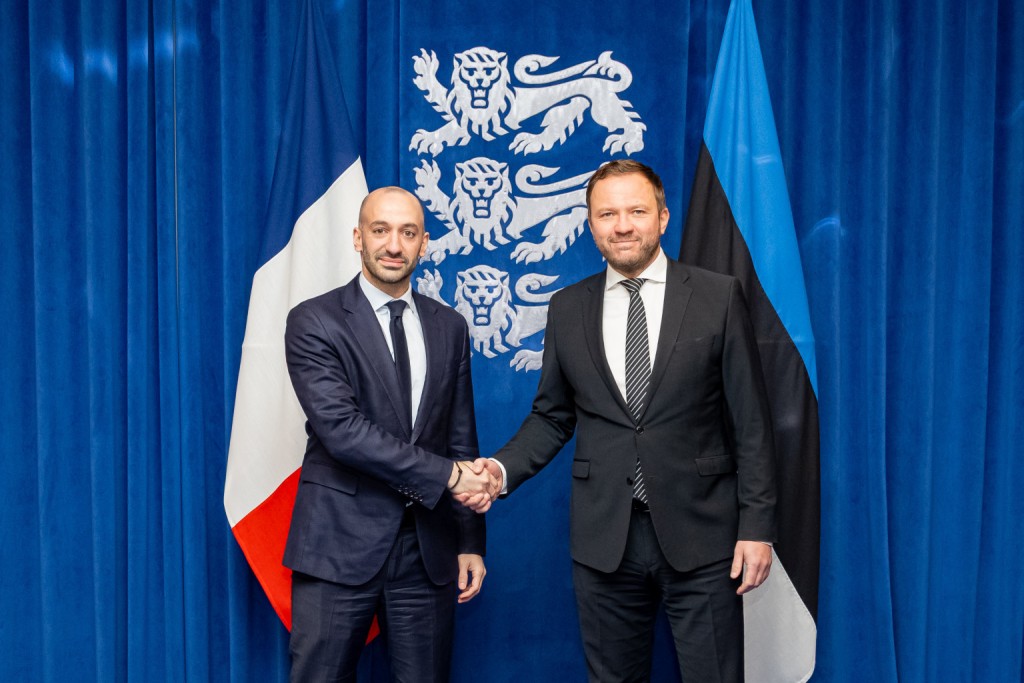
According to Foreign Minister Tsahkna, the new strategic partnership plan will help take the already close relations between Estonia and France to a new level. “France’s contribution to the security of NATO’s eastern flank, including its participation in NATO’s battlegroup in Estonia, is invaluable. The road map signed today aims to further deepen our defence cooperation, while also expanding ties in the fields of the economy and innovation and promoting cooperation in culture and education.”
The minister added that the road map also confirms the shared determination of Estonia and France to strengthen European security more broadly. “In the current tense geopolitical situation, it is vital that Europe increases its defence capabilities and strategic resilience,” Tsahkna noted. “We must continue to raise defence spending and strengthen Europe’s security architecture.”
Speaking about Russia’s aggression in Ukraine, Tsahkna stressed that Europe must remain staunchly by Ukraine’s side. “Moscow has clearly shown that it is not interested in peace. We see this especially clearly through its intense attacks against Ukraine’s energy infrastructure in the winter, aimed at leaving Ukrainians in the cold and darkness,” he said.
“Russia’s terror must not go unpunished. We need a strong 20th sanctions package that places serious pressure on Russia’s economy, targeting above all Russia’s fossil fuel exports, and we must continue to deter Russia’s shadow fleet. We must also move forward with establishing a special tribunal for the crime of aggression under the auspices of the Council of Europe, which would set a precedent that no violation of international law will go without consequences.”
The ministers also discussed introducing a ban on entry to the Schengen area and on the issuance of residence permits for all Russian citizens who have fought for Russia in Ukraine.
“To protect the security of European societies, entry into the Schengen area must be banned for Russian fighters, who include convicted criminals who were sent to the front from prisons and individuals who are clearly hostile towards Europe,” Tsahkna said.
Discussing EU enlargement, Tsahkna emphasised that keeping the accession door open must remain a core principle of EU policy, especially at a time when candidate countries are making significant efforts to implement reforms. “That is why it is vital to open the first cluster of chapters required for accession negotiations with both Ukraine and Moldova, sending a clear signal that the EU supports their path and recognises the progress they have made so far,” Tsahkna noted.
As part of the visit, the ministers will attend events today in Kadriorg and at the National Library of Estonia dedicated to the anniversary of the Tartu Peace Treaty. Tomorrow, they will visit French troops serving in NATO’s battlegroup in Tapa, the Neo Performance Materials (NPM) magnet factory, and the Narva border crossing point.
The joint press conference of the foreign ministers can be watched again here.
Photos from the visit.

